
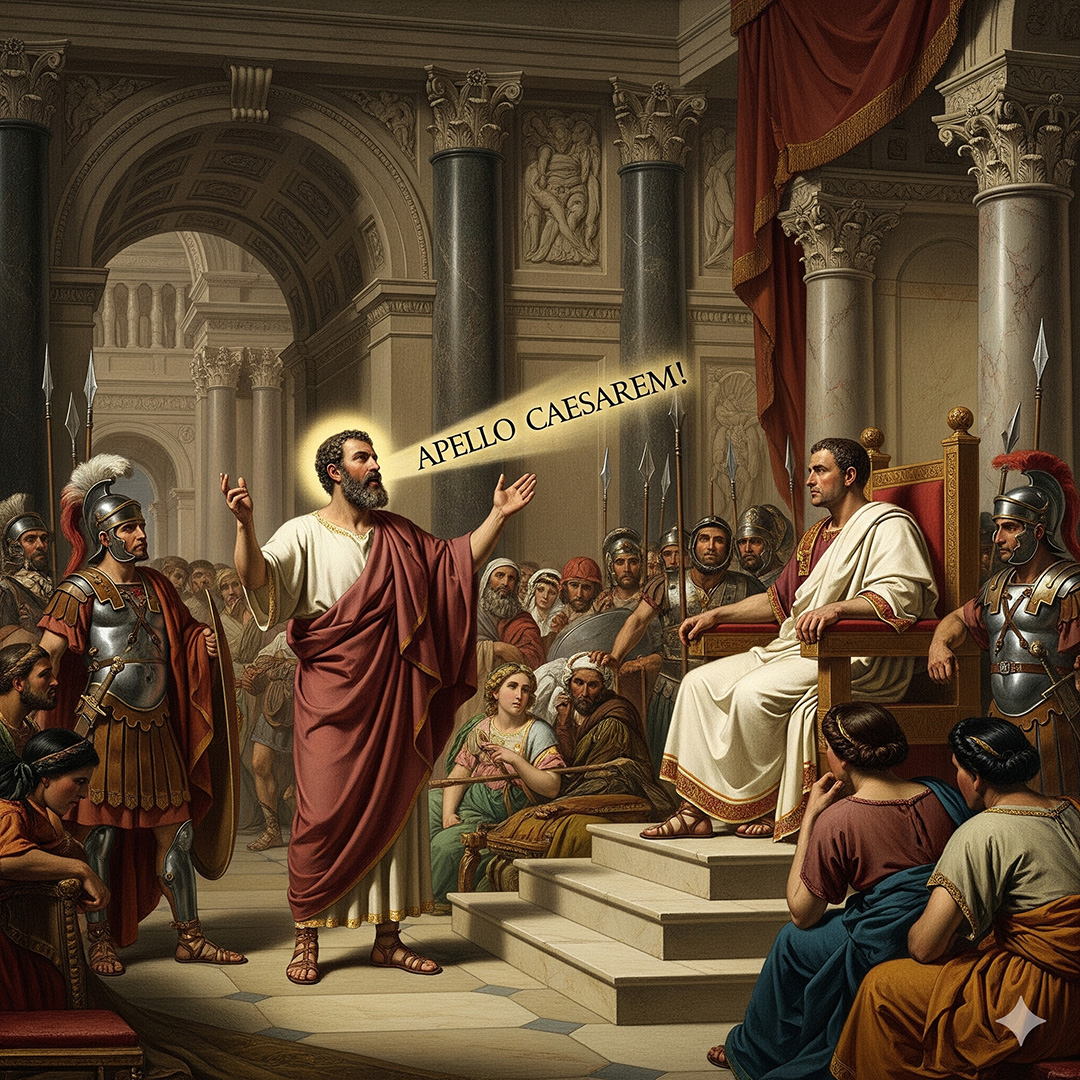
Summarize Acts 25 & 26 in a paragraph (under 7 sentences). There Paul appeals to Caesar. Then when Agrippa and Festus hear the case together, Agrippa says in verse 32, “He could have been set free if he hand’t appealed to Caesar.” Explain the historical background for this. Was it that once you appeal to Casar, you must see it through? Couldn’t they ask Paul to cancel that appeal? Also, why were the governors (both Felix and Festus) so eager to please the Jews?
Response:
In Acts 25 & 26, after two years of imprisonment, Paul stands before the new governor, Porcius Festus. To avoid being sent to Jerusalem where an ambush awaits, Paul, as a Roman citizen, exercises his legal right to appeal his case directly to the Emperor in Rome. While awaiting transfer, Festus has Paul present his case to King Herod Agrippa II and his sister Bernice, who are visiting Caesarea. Paul gives a powerful testimony of his life, his conversion on the road to Damascus, and the message of Christ’s resurrection. Festus declares Paul is mad, but Agrippa, deeply moved, admits Paul has done nothing worthy of death or imprisonment. Agrippa then tells Festus that Paul could have been freed had he not appealed to Caesar.
The Unstoppable Appeal to Caesar
The statement by King Agrippa II in Acts 26:32, “This man could have been set free if he had not appealed to Caesar,” reveals a crucial aspect of Roman law and God’s sovereign plan.
Historically, the right to appeal to Caesar (provocatio ad Caesarem) was one of the most significant privileges of a Roman citizen. This right protected citizens from the arbitrary, and potentially corrupt, judgments of provincial governors. When a citizen faced a capital charge, they could bypass the local judiciary and have their case heard by the supreme tribunal in Rome.
Paul invoked this right at a critical moment (Acts 25:10−11). Governor Festus, new to the job and wanting to appease the Jewish leaders, suggested moving the trial to Jerusalem. Paul knew this was a death sentence, as his enemies had plotted to kill him on the road (Acts 25:3). His appeal was not just a legal strategy; it was a life-saving maneuver that also perfectly aligned with God’s stated will for him to bear witness in Rome (Acts 23:11).
Once the appeal was made and accepted by the governor, the legal process was irrevocable. At that moment, legal jurisdiction was officially transferred from the provincial court of Festus to the imperial court in Rome. Festus no longer had the authority to acquit or condemn Paul; his only remaining duty was to send the prisoner to the Emperor with a summary of the charges. Agrippa, after hearing Paul’s defense, recognized his innocence under both Jewish and Roman law. However, his hands were tied by the Roman legal system. Neither he nor Festus could simply ask Paul to “cancel” the appeal. The legal machinery was already in motion, and to reverse it would be to usurp the Emperor’s authority—an act of insubordination no governor would dare commit.
Why Governors Eagerly Pleased the Jews
The eagerness of both governors, Antonius Felix and Porcius Festus, to placate the Jewish authorities stemmed from the political reality of first-century Judea. 🏛️
- A Volatile Province: Judea was one of the Roman Empire’s most rebellious and politically sensitive provinces. The Jewish population deeply resented Roman occupation, and messianic fervor often fueled uprisings by groups like the Zealots. A governor’s primary job was to maintain order and the flow of tax revenue. A major revolt would be a catastrophic failure on his record, likely ending his career and possibly his life. Therefore, keeping the local leadership—the Sanhedrin—happy was a key strategy for maintaining the uneasy peace, the Pax Romana.
- Personal Corruption (Felix): The governor Felix (in office from roughly A.D. 52-58) was notoriously corrupt. The historian Tacitus described him as ruling “with the authority of a king and the instincts of a slave.” The Bible itself notes that Felix kept Paul imprisoned for two years, hoping Paul would offer him a bribe for his release (Acts 24:26). When Felix was recalled to Rome, he left Paul in chains “as a favor to the Jews” (Acts 24:27), likely to prevent them from sending a delegation to Rome to accuse him of his misdeeds during his tenure.
- Political Expediency (Festus): Festus, who took office around A.D. 59, was new and wanted to start on the right foot with the local aristocracy. When the chief priests immediately brought up Paul’s case, Festus saw an opportunity to build goodwill. His suggestion to move the trial to Jerusalem was a political concession, an attempt to show the Sanhedrin he was willing to cooperate. He valued political stability over justice for one man.
In the end, the political maneuvering of these Roman governors, intended to pacify the Jewish leaders, inadvertently became the very mechanism God used to fulfill His promise. It was their desire to please men that forced Paul to appeal to Caesar, setting him on the path to preach the Gospel in the heart of the Roman Empire, just as the Lord had ordained.