
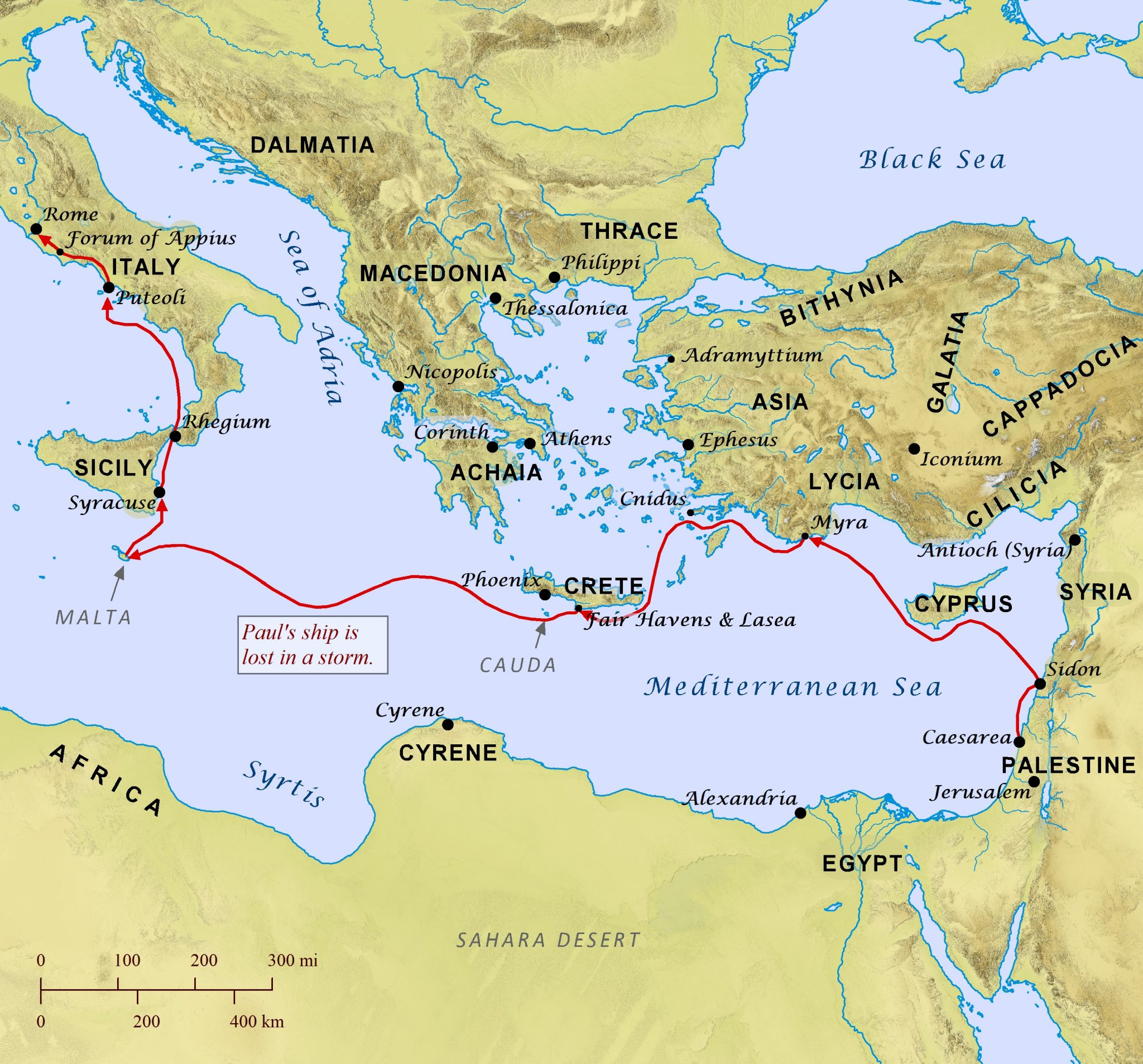
This journey, which took place around 59-60 AD, was a perilous voyage by sea that ultimately fulfilled God’s promise that Paul would testify in Rome.
The Journey from Caesarea to Myra
The voyage began in Caesarea Maritima, a Roman port city in Judea (modern-day Israel), where Paul had been held as a prisoner for two years. He was entrusted to a centurion named Julius, of the Augustan Cohort, who treated him with kindness. The first leg of the journey was on a coastal ship from Adramyttium, sailing to ports in the Roman province of Asia (Acts 27:1-2).
- From Caesarea to Sidon: The ship’s first stop was Sidon, a historical Phoenician city in modern Lebanon. Julius allowed Paul to visit his Christian friends there and receive their care (Acts 27:3).
- Distance: ~ 70 nautical miles (~80 mi / 130 km)
- From Sidon to Myra: After leaving Sidon, the ship faced strong head winds, forcing them to sail under the lee (the sheltered side) of Cyprus. They then sailed across the open seas off the coasts of Cilicia and Pamphylia (modern-day Turkey) before reaching the port of Myra in Lycia. This was a common route for ships traveling west from the Levant to avoid strong westerly winds.
- Distance: ~500 nautical miles (~575 mi / 925 km)
The Journey from Myra to Fair Havens
In Myra, the centurion found a large grain ship from Alexandria, Egypt, that was bound for Italy (Acts 27:6). This detail is historically significant, as Rome heavily relied on Egyptian grain to feed its population, and these ships were among the largest and most frequent vessels in the Mediterranean.
- From Myra to Cnidus: The journey continued, but the sailing was slow and difficult due to persistent winds. They had trouble reaching Cnidus, a city on the southwest tip of Asia Minor (Acts 27:7).
- Distance: ~130 nautical miles (~150 mi / 240 km)
- From Cnidus to Fair Havens: Since the winds prevented a direct course, the captain opted to sail south under the lee of the island of Crete, a much more sheltered route. They sailed with great difficulty until they reached a harbor called Fair Havens, near the city of Lasea (Acts 27:8).
- Distance: ~140 nautical miles (~160 mi / 260 km)
At this point, the sailing season was coming to a close. As a sailor, Paul advised them to winter at Fair Havens, but the centurion and the ship’s owner chose to continue on to a better harbor called Phoenix (Acts 27:9-12).
The Shipwreck and Winter in Malta
Shortly after leaving Fair Havens, a violent, northeasterly storm called a “Northeaster” or “Euraquilo” struck the ship, dragging it out into the open sea. For 14 days, the ship was completely out of control, drifting across the sea of Adria (the central Mediterranean, not the modern Adriatic Sea). During this time, the sailors and passengers lost all hope of survival (Acts 27:14-20). It was here that Paul delivered a prophecy from an angel of God, assuring them that although the ship would be lost, not a single life would be (Acts 27:21-26).
- The Shipwreck on Malta: As prophesied, on the 14th night, the sailors sensed they were nearing land. The ship ran aground on a sandbar off the coast of an island and was destroyed by the surf. As Paul had promised, all 276 people on board—passengers and crew—were saved, some by swimming and others by floating on planks and debris (Acts 27:41-44). The island was identified as Malta (Acts 28:1). Paul and his companions spent three months there during the winter, where Paul performed miracles of healing, establishing a foundation for the Christian faith on the island.
- Distance: 600 nautical miles ( 690 mi / 1,100 km)
The Final Leg to Rome
In the spring, they boarded another ship from Alexandria that had wintered in Malta. This ship, which had the twin gods Castor and Pollux as its figurehead, would take them on the last leg of the journey to Rome (Acts 28:11-12).
- From Malta to Syracuse: Their first stop was Syracuse, a major port city on the island of Sicily, where they stayed for three days.
- Distance: ~90 nautical miles (~100 mi / 160 km)
- From Syracuse to Rhegium: From there, they sailed to Rhegium (modern-day Reggio Calabria), a port city on the toe of Italy, where they waited for a favorable wind.
- Distance: ~70 nautical miles (~80 mil / 120 km)
- From Rhegium to Puteoli: With a south wind, they sailed to Puteoli (modern-day Pozzuoli), on the Bay of Naples, the major port for Rome. Here, Paul found other Christians and stayed with them for seven days (Acts 28:13-14). This was the end of his sea journey.
- Distance: ~200 nautical miles (~230 mi / 370 km)
- From Puteoli to Rome: From Puteoli, the group traveled by land, walking about 150 miles along the famous Roman road, the Appian Way. Along the way, they were met by Roman Christians at two places, Appii Forum and Three Taverns, who had come to welcome and encourage Paul (Acts 28:15-16). This was a significant moment, demonstrating the unity of the early Church and the fulfillment of Paul’s long-held desire to visit the Christians in Rome (Romans 1:10-15).
Paul finally arrived in Rome, where he was placed under house arrest for two years, allowed to live in his own rented quarters with a Roman guard (Acts 28:16, 30). From there, he continued to boldly proclaim the Gospel of Jesus Christ to all who came to him, bringing the story of the Gospel to the very heart of the Roman Empire, just as God had intended.
Distances and Historical Scale
While the Bible does not provide exact distances, historical and geographical data allow us to estimate the scale of this remarkable journey. The total distance traveled by sea and land was approximately 2,130 miles.
- Sea Voyage: Roughly 1,920 miles.
- Land Journey: Approximately 210 miles.
The journey was a combination of slow sailing, a two-week storm, a three-month winter delay, and a final week of travel by sea and land. The time from the start of the storm to their arrival in Rome was at least four months, but the entire journey from Caesarea likely took closer to five or six months in total.
This treacherous voyage, a culmination of God’s sovereign plan, highlights both the dangers of ancient sea travel and the unwavering faith of Paul. Luke’s account, with its vivid nautical detail, is considered by many historians to be one of the most accurate descriptions of a sea journey from the ancient world. It serves as a powerful testament to God’s providence, showing that no storm, political imprisonment, or human obstacle could prevent His will from being accomplished.
Credit: The map image above is from Bible Mapper (https://biblemapper.com/blog/index.php/2021/05/24/pauls-voyage-to-rome/).