
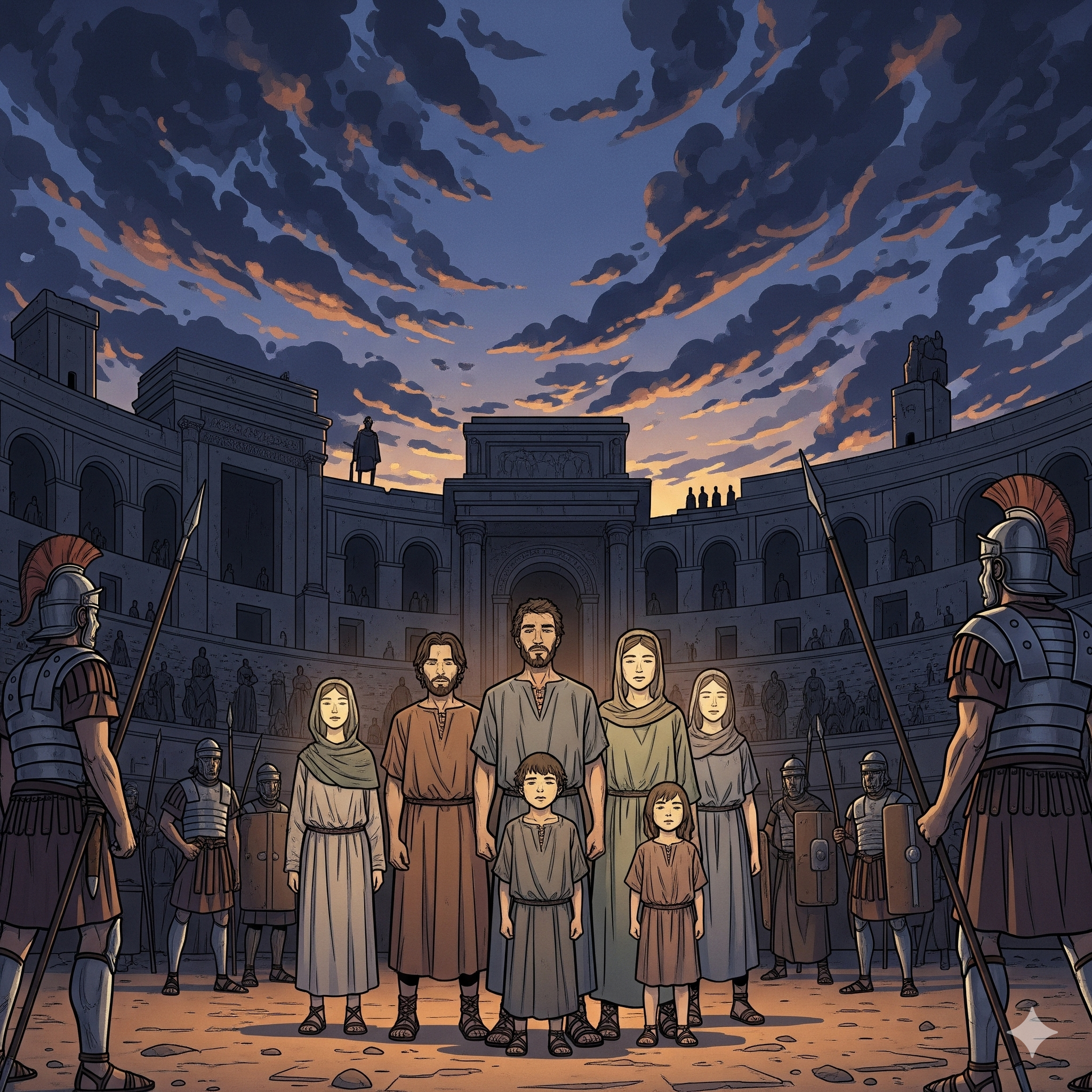
The story of the first major persecution of Christians is a powerful intersection of Biblical accounts, Church tradition, and Roman history. While the Bible provides a glimpse into the final days of the Apostle Paul, it is secular historical records and early Christian writings that fill in the dramatic and tragic details of his death and the brutal persecution that swept Rome. This narrative weaves together these sources to paint a complete picture.
Paul’s Final Days and Death
The biblical account of Paul ends in Acts 28, where he is under house arrest in Rome around AD 62, awaiting trial before Caesar, who was then Nero. Scripture does not provide the outcome of this trial or the details of Paul’s death. However, in his final letters, particularly 2 Timothy, Paul seems to sense his end is near, writing, “The time of my departure is at hand” (2 Timothy 4:6). He accepted that his life was a sacrifice to be “poured out” in service to Christ.
Church tradition, supported by early Christian writers, provides the details of his martyrdom. Clement of Rome (c. AD 95) wrote that Paul “bore witness before the rulers” and was martyred. Tertullian (c. AD 200) and Eusebius (c. AD 325) both record that Paul was beheaded in Rome under Nero. As a Roman citizen, Paul was spared the agonizing death of crucifixion and was instead granted a quicker, more “honorable” execution by the sword. His death is believed to have occurred between AD 64–67 outside the walls of Rome.
Nero and the Great Fire of Rome
The catalyst for this persecution was a massive fire that began on July 18, AD 64, and raged for six days, destroying a large part of Rome. The Roman historians Tacitus, Suetonius, and Cassius Dio all suggest that many Romans suspected Emperor Nero himself started the fire to clear land for his lavish new palace complex, the Domus Aurea. To deflect this widespread suspicion and public outrage, Nero needed a scapegoat.
He chose the Christians, a small, misunderstood, and unpopular group. Christians were already viewed with suspicion by Roman society for several reasons: they refused to worship the Roman gods, which was seen as a form of “atheism”; their private worship and Lord’s supper were misinterpreted as strange and immoral practices; and their communal language of “brother” and “sister” was misunderstood as incest. Accusing them of the fire was a convenient way for Nero to divert attention from himself.
The Persecution and its Victims
Nero’s persecution was the first state-sponsored persecution of Christians and was marked by extreme cruelty. The Roman historian Tacitus provides a vivid account in his Annals (15.44), detailing the horrific methods of execution:
- Human Torches: Christians were covered in pitch and set on fire to serve as human torches to light Nero’s gardens at night.
- Torn by Animals: Many were dressed in animal skins and thrown to wild dogs and beasts in the Roman arenas.
- Crucifixion: Others were crucified, often in public spectacles.
It was during this brutal persecution that tradition holds the apostles Peter and Paul were martyred. As a non-citizen, Peter faced a more severe fate. According to early Church tradition, he was crucified but requested to be crucified upside down, feeling unworthy to die in the same manner as his Lord. This is believed to have taken place on Vatican Hill, at the site of Nero’s Circus.
The Bible’s Witness and the Survivors
While the Bible does not explicitly mention Nero or the fire, it provides contextual clues. In his letters, Paul refers to “Caesar,” which was Nero. The apostle Peter’s first epistle speaks of a “fiery trial” facing believers (1 Peter 4:12), which many scholars interpret as a reference to the persecution in Rome. Later, the Book of Revelation, written during a later persecution, describes a “beast” opposed to God’s people, with the number 666 often interpreted as a coded reference to Nero.
While Paul and Peter perished, others survived. Apostles like John continued their ministry. John was the only one of the original twelve apostles to not die a martyr’s death, though he was exiled to the island of Patmos where he wrote the Book of Revelation. He lived to an old age, becoming a crucial witness to the enduring faith of the early Church. Other early Christian leaders like Luke, Timothy, and Mark also survived and carried on the mission, ensuring that the Gospel message could not be extinguished by the brutality of an emperor. The church in Rome, though tested by fire, emerged stronger, a testament to a faith that could not be silenced.