
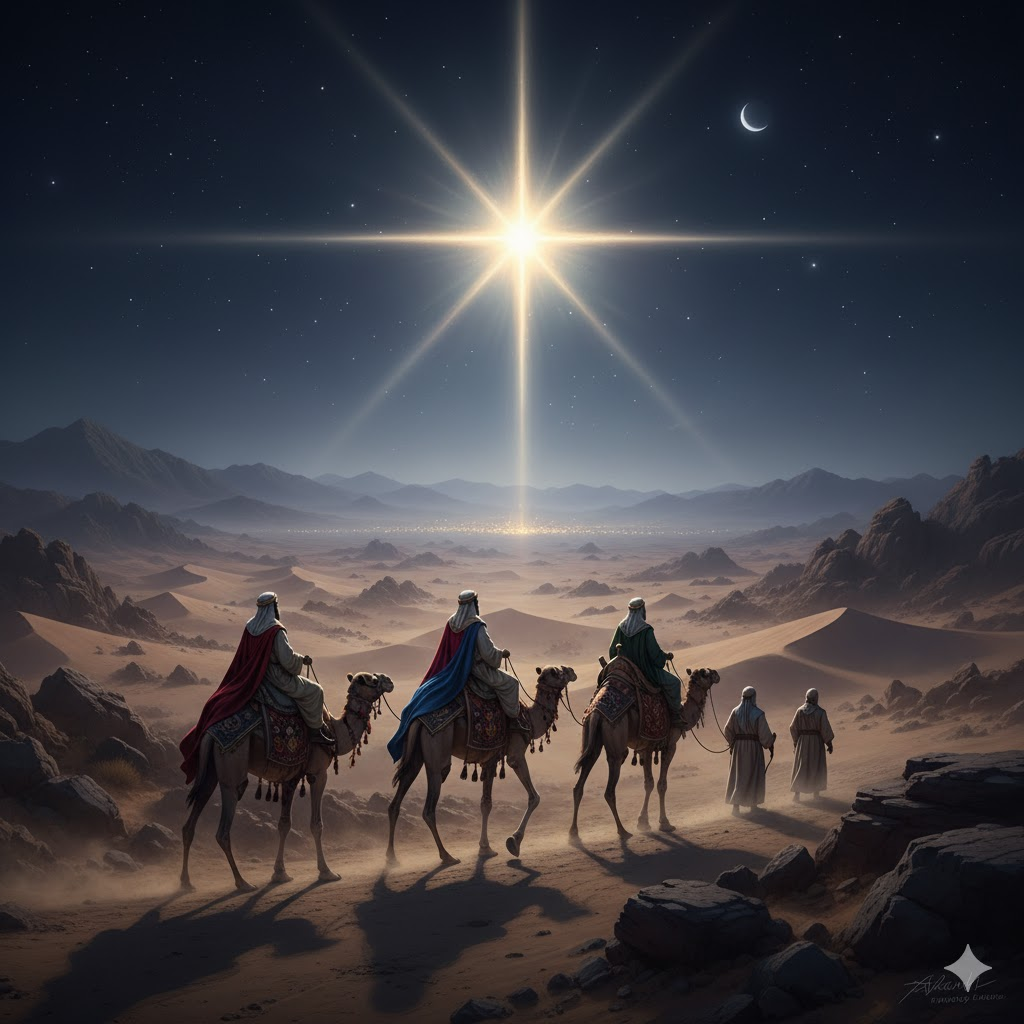
In Matthew 2, Jesus was born in Bethlehem. Then the three wise men appear and who saw a star and recognized a new King of the Jews was born. Let’s first discuss who the wise men are. Why were they just described as wise men and no other description? Who/what were they? The fact that they went to King Herod to ask about it tells me that they weren’t religious and weren’t familiar with the Scriptures. Secondly, what is their significance in history in the context of Jesus’ birth?
The central point to grasp is that the “wise men” were not just random travelers; they were Magi (Greek: magoi), a term loaded with historical and religious context.
1. Identity of the Wise Men (Magi)
Who/What They Were
The term used in the original Greek of Matthew 2 is μαˊγoι (magoi). The best historical understanding is that they were a learned, priestly class from the East, most likely from the ancient regions of Persia (Parthia) or Babylonia.
- A Priestly Caste: Historically, the Magi were associated with the ancient Persian religion, particularly Zoroastrianism, a highly respected and influential group. They were known for their specialized knowledge, particularly in astronomy, interpretation of dreams, and ancient wisdom. The English word “magic” comes from this same root, but in the context of Matthew, it means an esteemed scholar or sage.
- From the East: Matthew specifies they came “from the East” (apo anatolōn, Matthew 2:1). This geographically points toward the lands east of Judea, where astronomical knowledge was highly developed. During this period, the Parthian Empire (Persia) was Rome’s great rival, and its learned men were highly regarded.
- Not Kings (Scripturally): While later Christian tradition—likely influenced by prophecies like Psalm 72:11 (“May all kings fall down before him”) and Isaiah 60:6—referred to them as “kings,” the Bible itself does not give them this title. The number three is also a later tradition, based on the three gifts they brought: gold, frankincense, and myrrh (Matthew 2:11).
- Not at the Manger (When and Where): The visit of the Magi took place in Bethlehem, but not on the night of Jesus’ birth. Matthew 2:11 says they came into a house (oikian) and saw the child (paidion), not an infant in a stable. Herod’s subsequent order to kill all boys two years old and under (Matthew 2:16), based on the time he learned of the star’s appearance from the Magi, suggests the visit likely occurred months, or possibly up to two years, after the birth.
Why “Wise Men” and Not Other Descriptions?
The primary reason is the Greek word μαˊγoι was best translated into early English versions as “wise men” to convey their status as sages, scholars, and men of learning—a social designation rather than a formal religious or political one like “priests” or “kings.”
Familiarity with the Scriptures
Your intuition that they might not have been familiar with Jewish Scriptures is partially correct, but their overall background suggests a crucial connection that God used to guide them:
- Indirect Knowledge: It is highly probable that the Magi had indirect knowledge of Jewish messianic prophecy. For centuries (beginning around 605 BC, during the time of the prophet Daniel), the Jewish people had lived in exile in Babylon and Persia. The prophet Daniel himself was made chief of the magi or “wise men” in the court of Babylon (Daniel 2:48). Daniel would have educated this priestly caste in the worship of the God of Israel and the prophecies of the Messiah.
- The Star Prophecy: They were guided by a special “star” (Matthew 2:2). This connects to the prophecy of Balaam, who was from the same region of the East (Pethor on the Euphrates) and predicted: “A star shall come out of Jacob, and a scepter shall rise out of Israel” (Numbers 24:17). The Magi, as experts in celestial events, would have been familiar with this ancient prophecy concerning a Jewish King.
- The Scripture Confirmation: Their journey led them to Jerusalem—the capital and seat of the current King Herod—because they assumed a new King of the Jews would be born there. When they asked Herod, it was the Jewish chief priests and scribes who immediately cited Micah 5:2 to pinpoint the location: “But you, Bethlehem Ephrathah, though you are small among the clans of Judah, out of you will come for me one who will be ruler over Israel.” The Magi needed the Scripture (Old Testament) to confirm where to go, but they used their own tradition (the star) to confirm that the King was born.
2. Significance in History and the Biblical Context
The arrival of the Magi is profoundly significant, acting as a crucial bridge between the Old and New Testaments and revealing the nature of Jesus’ mission.
A. Fulfillment of Old Testament Prophecy
The visit explicitly fulfills prophecies that God’s plan extends beyond Israel to the nations (the Gentiles):
- Isaiah 60:6 describes the nations bringing tribute to Jerusalem: “Herds of camels will cover your land, young camels of Midian and Ephah. And all from Sheba will come, bearing gold and frankincense and proclaiming the praise of the LORD.“
- Psalm 72:10-11 speaks of foreign kings and nations paying homage to the Messiah: “The kings of Tarshish and of the coastlands will render tribute; the kings of Sheba and Seba will offer gifts. May all kings fall down before him, all nations serve him.“
B. Revelation of Universal Kingship
The most critical significance is that the Magi, as Gentiles and foreign dignitaries, are the first people recorded in Matthew’s Gospel to recognize, seek out, and worship Jesus as the King of the Jews (and thus, the Messiah).
- Their homage marks the inauguration of Christ’s claim to be the King of the entire world, not just a local Jewish ruler. God used the traditions of the Gentile world (astronomy, wisdom) combined with ancient Jewish prophecy to reveal His Son to the nations.
- The gifts themselves are symbolic of His identity:
- Gold 👑: A gift for a King.
- Frankincense 🙏: An aromatic resin used in temple worship, symbolizing His Divinity and role as a Priest.
- Myrrh ✝️: A costly oil used for embalming, symbolically foreshadowing His sacrificial Death and humanity.
In summary, the Magi’s journey is a powerful demonstration that God’s salvation through Jesus Christ was intended for all humanity—a theme that Matthew carries throughout his Gospel.