
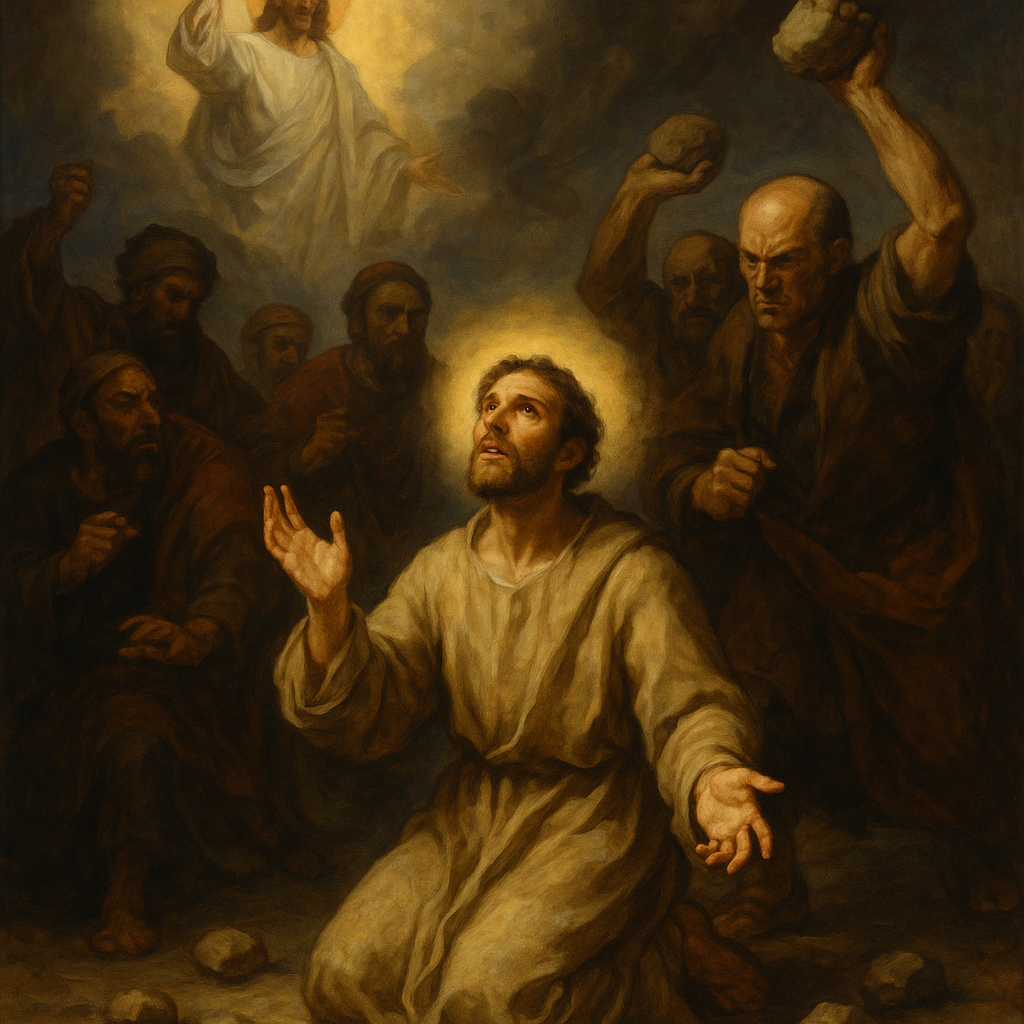
In Acts Chapter 7 in the Bible, instead of directly answering the high priest when he asked “is it true?” of all all the accusations brought upon him, Stephen basically gives a quick history lesson covering from Abraham to Solomon. Then goes on to accuse the Jewish leaders of their hypocritical behaviors and stubbornness which led to his being stoned to death. Explain the significance of this chapter. It’s a frequently mentioned story of Stephen. What can we learn from it beyond the obvious like Stephen’s courage and his act from being full of Spirit? In the previous chapter, he was one of seven who were selected to serve the people. Should he have been a little more sensitive to the situation for the long term influence he could’ve given? Or perhaps he just knew it was his time to play a martyr for God?
Response:
Excellent and deeply perceptive questions. The story of Stephen in Acts 6 and 7 is far more than a simple account of the first Christian martyr. It represents a pivotal turning point in the early church and contains a theological depth that is often missed. Let’s break down the significance of this chapter and address your specific, thoughtful questions.
The Significance of the “History Lesson”
You are correct that Stephen’s speech is not a direct, simple answer to the charges. The charges were that he spoke “blasphemous words against Moses and against God” and against “this holy place [the Temple] and against the law” (Acts 6:11, 13).
From a legal standpoint, a direct denial would have been useless before a hostile court like the Sanhedrin. Instead, filled with the Holy Spirit, Stephen employs a brilliant rhetorical and theological strategy. His “history lesson” is actually a masterful reinterpretation of Israel’s own sacred story, designed to do two things simultaneously:
- Defend his own position: He shows he has a deeper, more spiritual understanding of Moses, the Law, and the Temple than his accusers.
- Indict his accusers: He demonstrates that they are the ones who are truly repeating Israel’s historical pattern of rebellion against God.
Here’s how his argument unfolds:
- Theme 1: God is Not Confined to a Place. This is his primary defense against the charge of speaking against the Temple. He systematically shows that God’s presence and saving work have almost always happened outside of a permanent, physical structure in the land of Israel.
- God called Abraham in Mesopotamia, a foreign land.
- God was with Joseph and saved Israel through him while he was in Egypt.
- God appeared to Moses in the burning bush in Midian, on holy ground that was not the Temple Mount. He gave the Law on Mount Sinai, again, not in Jerusalem.
- For 40 years, God’s presence was in a mobile Tabernacle, a tent that moved with the people.
- Finally, he gets to Solomon’s Temple and delivers the theological knockout punch by quoting Isaiah 66: “However, the Most High does not live in houses made by human hands… Heaven is my throne, and the earth is my footstool. What kind of house will you build for me?” (Acts 7:48-49).
His point is devastating: You have accused me of blaspheming the Temple, but you are the ones who have committed idolatry by limiting the infinite God to a single building, a mistake even Solomon, its builder, understood.
- Theme 2: A Pattern of Rejecting God’s Messengers. This is where Stephen turns from defense to prosecution. He shows that the Sanhedrin’s rejection of Jesus is the tragic culmination of Israel’s long history of rejecting the saviors God sent them.
- Joseph’s brothers rejected him, yet he became their means of salvation.
- The Israelites rejected Moses (“Who made you ruler and judge over us?”), yet he was their God-appointed deliverer.
- They rejected the Law by worshiping the golden calf.
- They persecuted and killed the prophets who foretold the coming of Jesus.
Having laid this foundation, his final accusation is not just an emotional outburst but the logical conclusion of his entire argument: “You stiff-necked people! Your hearts and ears are still uncircumcised. You are just like your ancestors: You always resist the Holy Spirit!” (Acts 7:51). He accuses them of having the outward sign of the covenant (circumcision) but lacking the inward reality of a heart submitted to God—the very definition of hypocrisy.
What Can We Learn Beyond the Obvious?
Beyond his incredible courage, Stephen’s story teaches us several crucial lessons:
- How to Read the Old Testament: Stephen provides a masterclass in Christ-centered interpretation. He reads the Old Testament not as a collection of separate stories but as one unified narrative that points relentlessly to Jesus Christ. Joseph and Moses are presented as “types” or foreshadows of Jesus—rejected deliverers who ultimately provide salvation.
- The Sovereignty of God in Rejection: God’s plan is never thwarted by human rebellion. Joseph’s rejection led to the salvation of his family. Moses’ rejection was part of the path to the Exodus. In the same way, the Sanhedrin’s rejection of Jesus was the very means by which God accomplished the salvation of the world through the cross.
- The Turning Point for the Gospel: Stephen’s martyrdom is a watershed moment in Acts. It triggers a “great persecution” against the church in Jerusalem (Acts 8:1), causing the believers to scatter throughout Judea and Samaria. This “scattering” is precisely what spreads the gospel beyond the confines of Jerusalem, fulfilling the commission of Jesus in Acts 1:8. A man named Saul, who approved of Stephen’s execution, is introduced here. Stephen’s death plants a seed that will ultimately lead to Saul’s conversion and his mission to the Gentiles.
Should He Have Been More Sensitive? A Martyr, Not a Diplomat
This is a very practical and important question. From a purely human, strategic perspective, one might argue that a more diplomatic approach could have preserved his life and allowed him to continue his ministry of serving widows. But the text makes it clear that Stephen was not operating on human strategy.
- He was “full of the Holy Spirit” (Acts 7:55). His words were not his own calculated defense but a prophetic oracle from God for that moment. He was not trying to win a court case; he was tasked with delivering God’s verdict.
- He likely knew his fate. As he spoke, he would have seen the rage building in the faces of the Sanhedrin members, who were “furious and gnashed their teeth at him” (Acts 7:54). Rather than backing down, he pressed forward, empowered by the Spirit.
- His final vision of Jesus “standing at the right hand of God” is his ultimate vindication. Jesus is typically described as sitting at God’s right hand, a posture of completed work and authority. The fact that Stephen sees him standing is often interpreted as Jesus rising to welcome his first martyr, or to serve as his advocate and witness in the heavenly court. This vision confirmed for Stephen that his faithfulness unto death was not a failure, but a victory that was being honored in heaven itself.
In that moment, Stephen’s role was not to be a long-term administrator but to be a faithful witness. He was not called to be a diplomat; he was called to be a prophet and a martyr.