
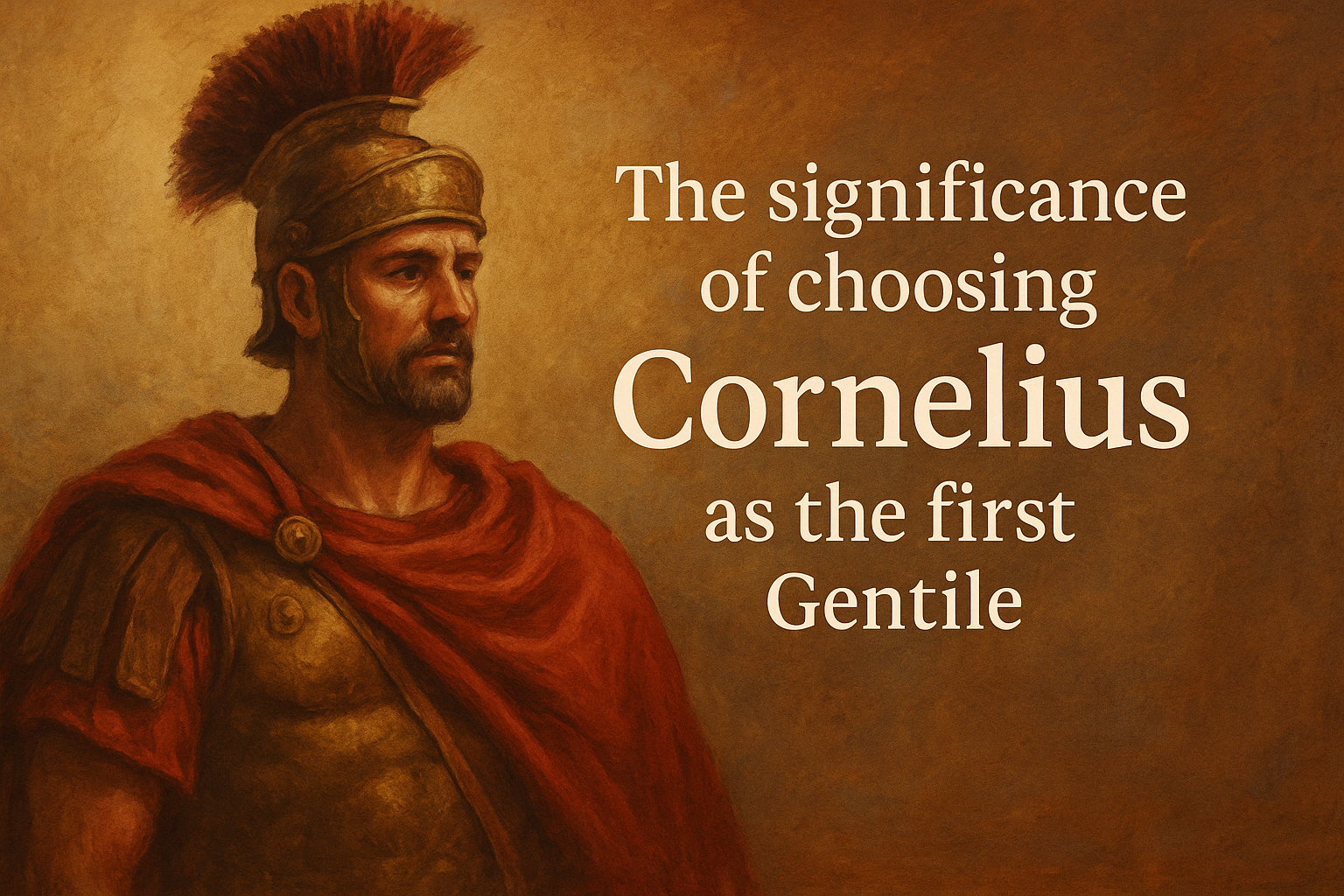
In Acts Chapter 10 in the Bible, Cornelius was chosen to be the first gentile to receive the Holy Spirit. He was a captain of the Italian Regiment. Up until this point, the disciples were only preaching and baptizing the Jews only. God appeared to Peter to confirm that it’s ok to share the Gospel with the gentiles, also. What is the significance of choosing Cornelius as the first gentile? I understand he was a God-fearing man, but there were probably some others who were also God-fearing. So wondering about the significance of Cornelius.
Response:
This is a profoundly insightful question that touches upon the very heart of the Church’s mission and the unfolding of God’s redemptive plan in the Book of Acts. To move beyond the simple (though correct) answer that Cornelius was a “God-fearing man” is to delve into the divine wisdom and strategic brilliance of God’s choice.
From a theological perspective, the selection of Cornelius was not arbitrary; he was, in many ways, the perfect candidate to serve as the “firstfruits” of the Gentile harvest for several overlapping and significant reasons.
1. Cornelius as the Epitome of the “Other”
To a first-century Jew, a Roman centurion was not just a Gentile; he was the embodiment of the occupying, oppressive, and pagan power of Rome. He represented the military might that subjugated God’s chosen people. By selecting a Roman officer, God was making the most radical statement possible: the Gospel is powerful enough to shatter the most hardened political, cultural, and military barriers. If the ultimate “enemy” could be brought into the family of God, then truly no one was outside the scope of His grace. It was a dramatic demonstration that in Christ, the dividing wall of hostility (Ephesians 2:14) was not just breached, but obliterated.
2. The Confluence of Worldly Power and Spiritual Humility
Cornelius was a centurion, a man of significant authority, discipline, and worldly respect. He commanded roughly 100 soldiers and was part of the elite “Italian Regiment.” Yet, the text goes to great lengths to describe his spiritual posture: he was “a devout man who feared God with all his household, gave alms generously to the people, and prayed continually to God” (Acts 10:2).
The significance here is twofold:
- It subverts worldly power structures. A Roman commander, a man used to giving orders, humbly seeks out and submits to the teaching of a Galilean fisherman. This is a living picture of the “upside-down” nature of the Kingdom of God, where the powerful bow before the humble to receive the words of eternal life.
- It shows that piety is no respecter of persons. One might expect to find such devotion in a synagogue, but to find it in the heart of a Roman barracks in Caesarea Maritima—the very seat of Roman governmental power in Judea—is a testament to the fact that the Spirit of God works in the most unexpected places.
3. The Model of Sincere, Yet Incomplete, Faith
Your observation that there were likely other “God-fearers” is astute. The term “God-fearer” (Greek: phoboumenos ton Theon) was a semi-technical term for Gentiles who were drawn to the monotheism and ethics of Judaism. They worshipped Yahweh and attended synagogue, but they had not taken the final step of full conversion, which would have included circumcision for males.
Cornelius represents this entire class of people. His piety, prayers, and almsgiving were sincere and “ascended as a memorial before God” (Acts 10:4). Yet, they were not sufficient for salvation. God honored Cornelius’s seeking heart not by declaring him “saved” on the basis of his works, but by sending him the one thing he lacked: the specific, explicit Gospel of Jesus Christ. This demonstrates a crucial theological principle: salvation is not achieved by moral sincerity or religious devotion alone, but only through faith in the person and work of Jesus. Cornelius’s story affirms that God meets us where we are, but He does so in order to lead us to Christ.
4. The Undeniable Public and Strategic Witness
The conversion of a private, unknown Gentile might have been easily dismissed by the skeptical church leaders in Jerusalem. But the conversion of a Centurion, a public figure with a household and a network of influence (“he had called together his relatives and close friends,” Acts 10:24), was a verifiable and high-profile event.
Furthermore, this event did not happen in a corner. It happened in Caesarea, a major Roman port and administrative center. The conversion of a man of Cornelius’s stature would have had strategic ripple effects, lending credibility to the Christian message within Roman society and perhaps even providing a measure of protection for the nascent church in that city. It was a divine “beachhead” for the Gentile mission.
5. The Unmistakable Parallel to Pentecost
Perhaps most critically for the internal life of the early Church, the event at Cornelius’s house was a “Gentile Pentecost.” As Peter was preaching, the Holy Spirit fell upon all the Gentiles present, and they began “speaking in tongues and extolling God” (Acts 10:46).
This was the undeniable, empirical proof that God Himself had sanctioned this new move. When Peter was later called to account by the “circumcision party” in Jerusalem, his entire defense rested on this fact: “As I began to speak, the Holy Spirit fell on them just as on us at the beginning… If then God gave the same gift to them as he gave to us when we believed in the Lord Jesus Christ, who was I that I could stand in God’s way?” (Acts 11:15-17).
God chose Cornelius and orchestrated the events in his home in such a way as to provide an irrefutable sign to Peter and the entire Jerusalem church. The visible and audible manifestation of the Spirit, mirroring the original Day of Pentecost, was God’s own testimony that Gentiles were to be accepted into the Church on equal footing with Jews, without first becoming Jewish proselytes.
In conclusion, Cornelius was far from a random choice. He was the perfect man, in the perfect position, at the perfect time, to serve as God’s chosen instrument to swing wide the doors of the Church to the entire world, demonstrating unequivocally the power, scope, and radical inclusivity of the Gospel of Jesus Christ.