
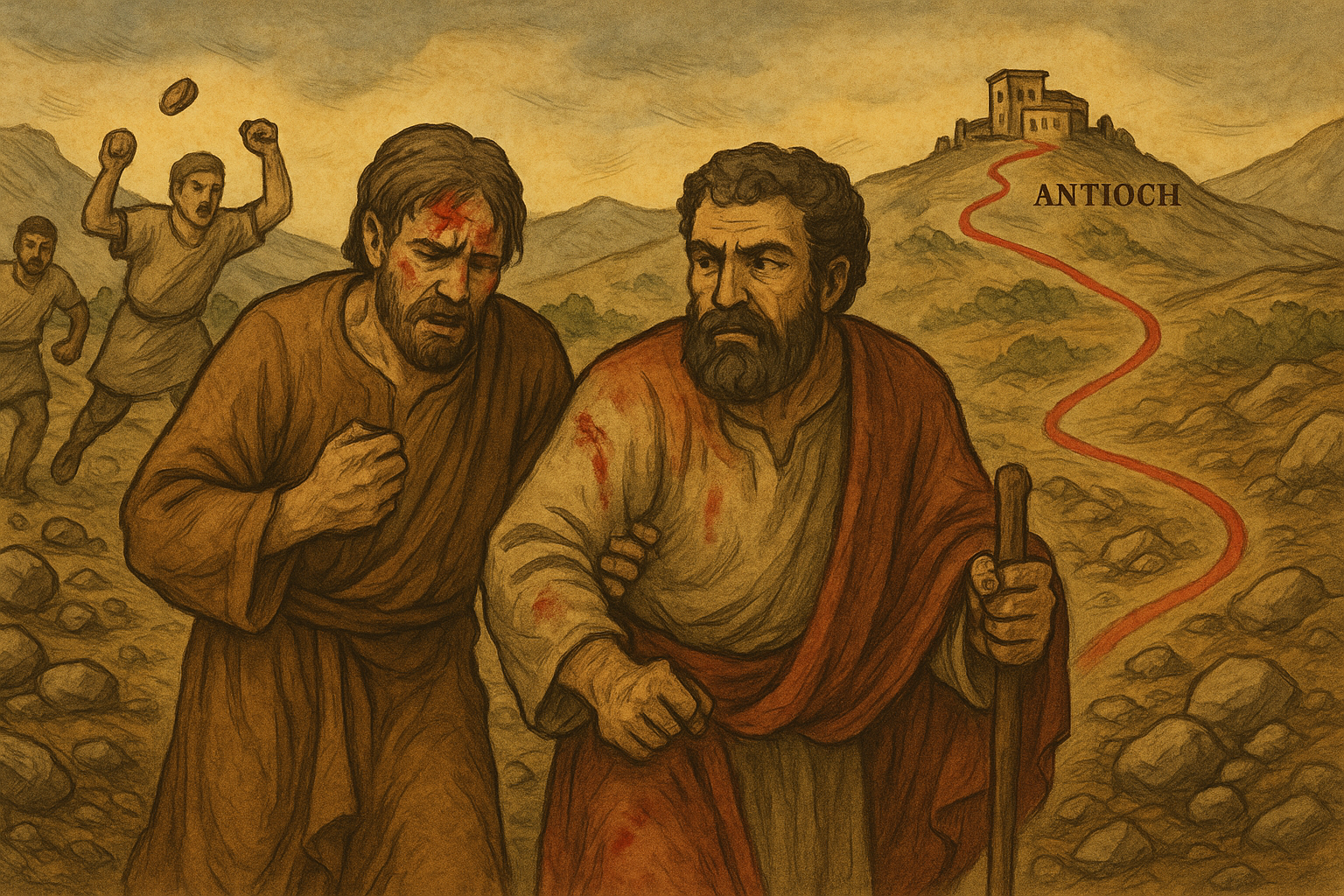
In Acts Chapter 14:22, Paul and Barnabas returned to Antioch and strengthened the believers there. And “they encouraged them to continue in the faith, reminding them that we must suffer many hardships to enter the Kingdom of God.” This could sound misleading since they know already we’re saved by the grace of God not by works. Why did Paul or Barnabas say this? Explain the context.
Response:
Let’s break down the context of Acts 14:22 so the statement “we must suffer many hardships to enter the Kingdom of God” is understood without making it sound like Paul and Barnabas were teaching salvation by works.
1. The Setting in Acts 14
- When & Where: Around AD 47–48, during Paul’s first missionary journey (Acts 13–14).
- Paul and Barnabas had just been to Iconium, Lystra, and Derbe (cities in the Roman province of Galatia).
- They had experienced fierce persecution:
- Driven out of Antioch in Pisidia (Acts 13:50).
- Nearly stoned in Iconium (Acts 14:5–6).
- Actually stoned and left for dead in Lystra (Acts 14:19).
After such ordeals, they revisited these same cities to strengthen the believers despite the danger.
2. What They Actually Meant
The Greek phrase for “enter the kingdom of God” here (εἰσελθεῖν εἰς τὴν βασιλείαν τοῦ θεοῦ) is not about how you “get saved” in the justification sense, but about the journey toward the fullness of God’s kingdom.
Key Clarification:
- Justification (being saved) happens instantly by grace through faith in Christ (Ephesians 2:8–9).
- Entering the Kingdom fully in the New Testament often refers to living as a citizen of God’s reign and ultimately inheriting its consummation at Christ’s return.
- This journey includes suffering—not to earn salvation but because following Christ inevitably draws opposition (John 15:18–20; 2 Timothy 3:12).
3. Why Paul Said This
- They were setting expectations. New believers in Galatia were facing persecution from both Jewish and pagan communities. If they expected an easy life after conversion, their faith could collapse when hardship came.
- They were normalizing suffering as part of discipleship. Jesus Himself taught:
- “If anyone would come after me, let him deny himself, take up his cross, and follow me” (Mark 8:34).
- “In this world you will have trouble. But take heart; I have overcome the world” (John 16:33).
- They were teaching perseverance. Suffering is not the “ticket” to heaven, but the “road” we walk because of our allegiance to Christ (Philippians 1:29).
4. The Flow of Thought
- Saved by grace: Paul had already taught them salvation is by faith, not works (Acts 13:38–39).
- But the road is hard: Grace doesn’t remove trials; it gives strength to endure them.
- Suffering as evidence of kingdom living: When believers remain steadfast under persecution, it demonstrates their citizenship in God’s kingdom (cf. 2 Thessalonians 1:4–5).
5. Modern Analogy
It’s like telling a soldier:
“You’re already enlisted—you wear the uniform. But the path to victory will take you through battles, wounds, and fatigue. Stay strong.”
The battles don’t make you a soldier; they’re simply part of living as one until the war is over.
Summary:
Paul and Barnabas weren’t saying suffering earns you the Kingdom. They were reminding new believers that suffering is an inevitable part of the Christian journey toward the final fulfillment of God’s kingdom. This statement was about perseverance, not works-based salvation. Grace gets you in; endurance keeps you walking forward until you reach the finish line.