
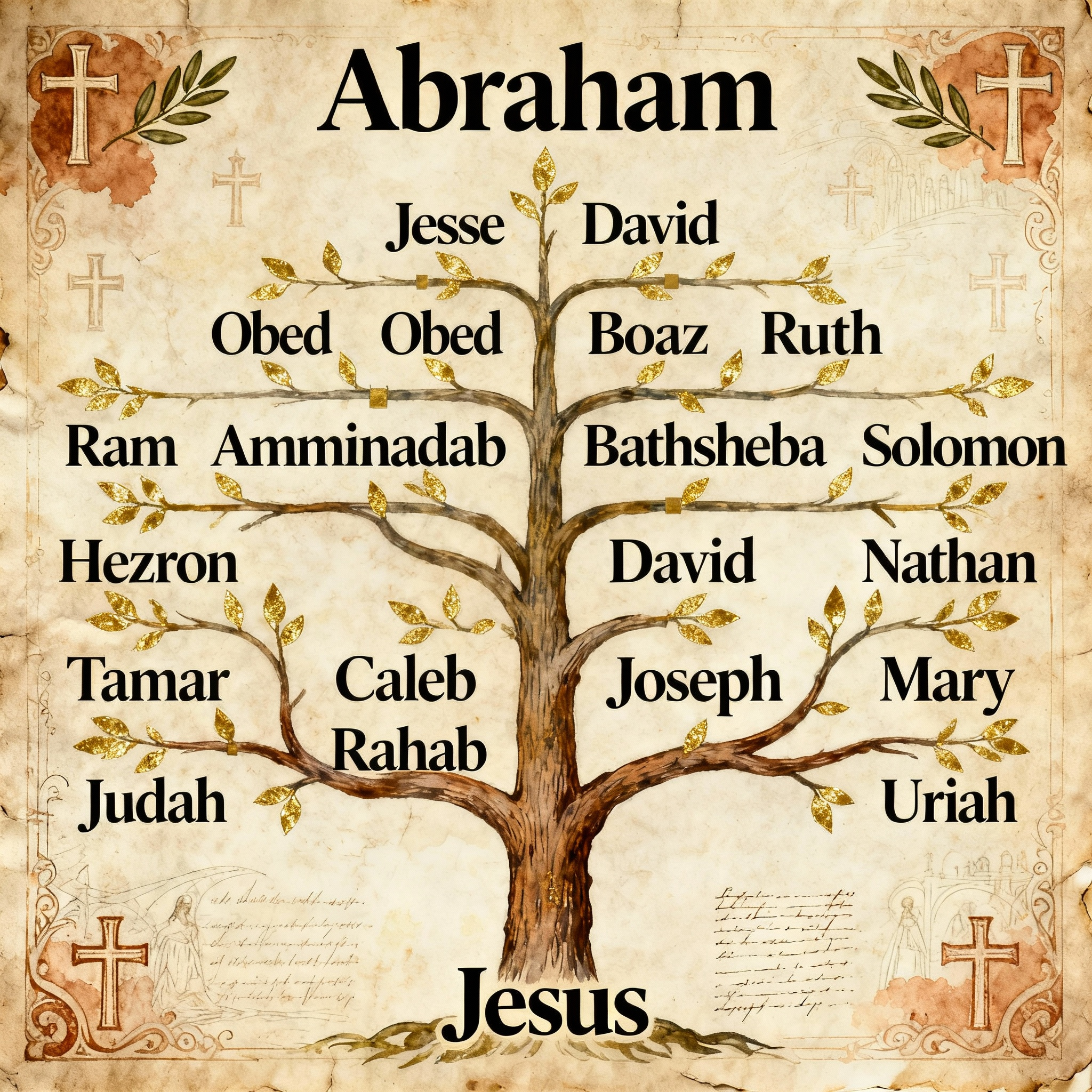
Let’s dig deeper into the significance of the Jesus’ genealogy written in Matthew 1. What are top three important takeaways from it?
…
The genealogy of Jesus presented in the first chapter of the Gospel of Matthew is far more than a simple family tree. It is a profound theological statement, rich with historical context and deep meaning. A careful examination reveals several key takeaways that are crucial for understanding the person and work of Jesus Christ. Here are three of the most significant:
1. Jesus is the Fulfillment of God’s Covenants with Israel
Matthew begins his Gospel by immediately establishing Jesus’ credentials as the long-awaited Messiah of Israel. He does this by connecting Jesus to two of the most significant figures in the Old Testament: Abraham and David.
- “The son of David, the son of Abraham” (Matthew 1:1): This opening verse is a powerful declaration.
- By calling Jesus the “son of Abraham,” Matthew places Him as the ultimate fulfillment of the covenant God made with Abraham in Genesis 12:1-3 and Genesis 22:18. This covenant promised that through Abraham’s offspring, all the nations of the earth would be blessed. Matthew is asserting that this universal blessing finds its ultimate expression in Jesus. This occurred historically with Abraham’s calling by God in approximately the 21st century B.C. in the ancient Near East, specifically in the region of Mesopotamia (modern-day Iraq) before he journeyed to the land of Canaan.
- The title “son of David” is equally crucial. It directly links Jesus to the Davidic Covenant found in 2 Samuel 7:12-16 and Psalm 89. God promised King David, who reigned in Jerusalem around 1000 B.C., that one of his descendants would establish an eternal kingdom. For a first-century Jewish audience, the “son of David” was a clear messianic title, signifying the rightful heir to the throne of Israel. Matthew’s genealogy meticulously traces this royal lineage, demonstrating that Jesus is not a usurper but the legitimate King.
By bookending his genealogy with these two towering figures, Matthew masterfully communicates that Jesus is the culmination of God’s redemptive plan for both Israel and the entire world, a plan set in motion centuries before His birth.
2. God’s Grace Extends to the Unconventional and the “Unworthy”
One of the most striking features of Matthew’s genealogy is the inclusion of five women, which was highly unusual in ancient patriarchal genealogies. What makes their inclusion even more remarkable is their backgrounds:
- Tamar (Matthew 1:3): A Canaanite woman who, out of a desire for justice and to continue her deceased husband’s line, deceived her father-in-law, Judah, into fathering her children (Genesis 38). Her story unfolds in the context of the patriarchal period, likely in the land of Canaan.
- Rahab (Matthew 1:5): A Canaanite prostitute from the city of Jericho who demonstrated faith in the God of Israel by hiding the Israelite spies (Joshua 2). This event took place during the Israelite conquest of Canaan, around the 15th or 13th century B.C.
- Ruth (Matthew 1:5): A Moabitess, a foreigner from a nation often at odds with Israel, who showed extraordinary loyalty to her Israelite mother-in-law, Naomi, and became the great-grandmother of King David (Book of Ruth). Her story is set in the period of the Judges, likely in the 12th or 11th century B.C., in Bethlehem.
- “The wife of Uriah” (Bathsheba) (Matthew 1:6): A Hittite woman who was involved in an adulterous affair with King David, which led to the murder of her husband (2 Samuel 11). This took place during David’s reign in Jerusalem.
- Mary (Matthew 1:16): A young virgin who conceived a child by the Holy Spirit before she was married, a situation that would have brought great social shame.
The deliberate inclusion of these women, many of whom were Gentiles and had what would be considered scandalous pasts, sends a powerful message: God’s grace is not limited by ethnicity, social status, or past sins. It demonstrates that God often works through unexpected and seemingly flawed individuals to accomplish His divine purposes. This foreshadows the very nature of Jesus’ ministry, which was characterized by His association with tax collectors, sinners, and outcasts.
3. The Deliberate Structure Points to a New Beginning
Matthew intentionally structures the genealogy into three sets of fourteen generations (Matthew 1:17):
- From Abraham to David: A period of God’s promises and the establishment of the kingdom.
- From David to the Babylonian Exile: A period of the monarchy’s decline and eventual judgment.
- From the Babylonian Exile to the Christ: A period of waiting and anticipation for the promised Messiah.
The number fourteen itself is significant. In Hebrew gematria (a system where letters have numerical values), the name “David” (D-V-D) adds up to fourteen (4+6+4). By structuring the genealogy around this number, Matthew is again emphasizing Jesus’ Davidic kingship.
More profoundly, this structured progression of history highlights that the coming of Jesus marks a new and climactic era in God’s plan of salvation. The periods of promise, failure, and exile all find their resolution and fulfillment in Christ. The birth of Jesus is not just another event in a long line of history; it is the pivotal moment toward which all of history has been moving. The Babylonian Exile, a traumatic event for the Jewish people, occurred in the 6th century B.C., and the genealogy shows God’s faithfulness even through periods of national disaster, leading to the ultimate restoration in the person of Jesus.