
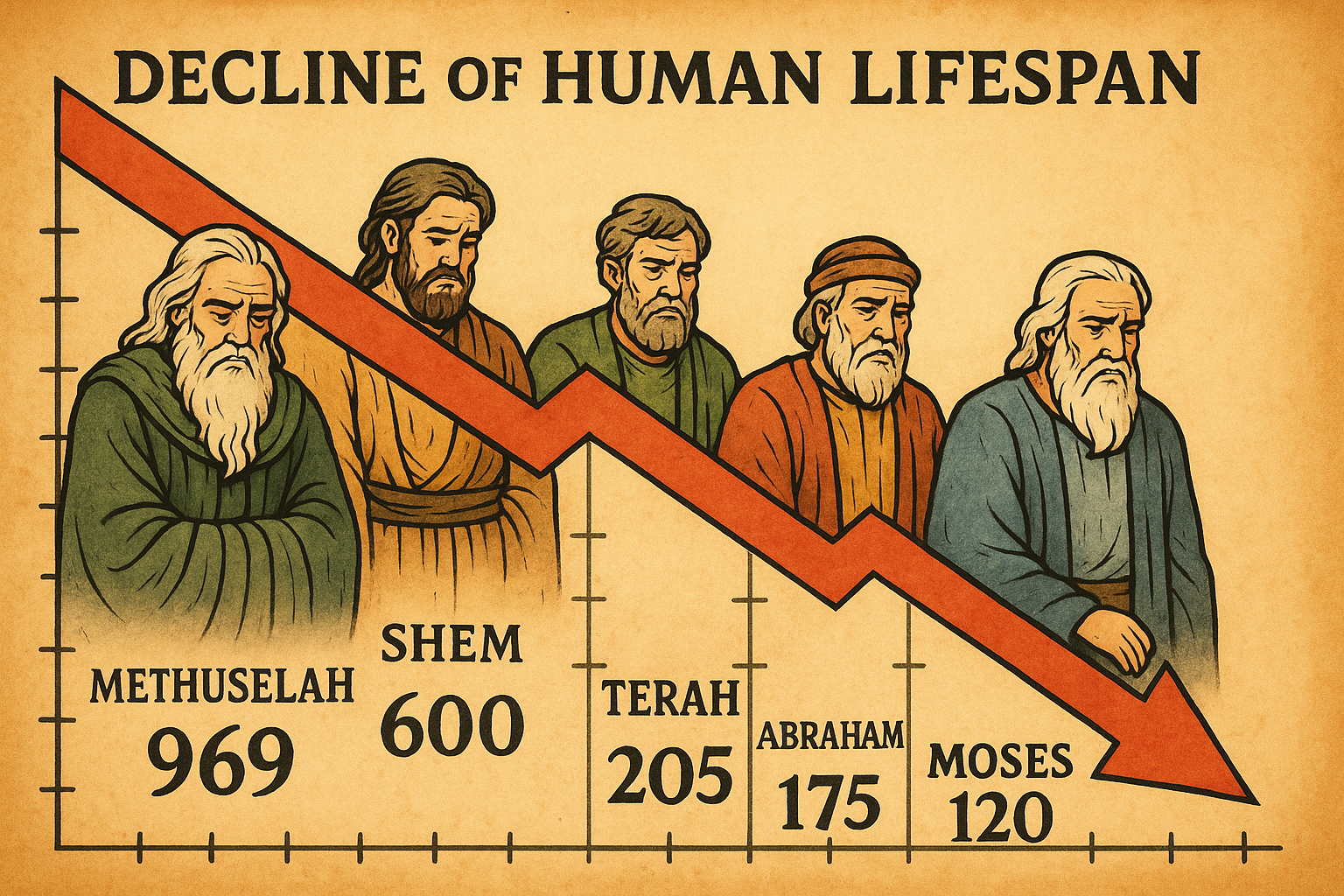
Back in the early days in the Old Testament of the Bible, people lived hundreds of years with Methusela living the longest at 969 years. I remember reading in the Bible that God had slashed the life expectancy of the people due to their wickedness. But also heard that people’s lives were getting shorter after the Noah’s arc incident when it rained for forty days and forty nights as God intended. Explain when and how the people’s life expectancy got shorter over time.
Response:
This is a deep and fascinating question that blends theology, biblical interpretation, and ancient worldview. Let’s explore it in layers—as a theologian, Christian apologist, and historian—so we can understand whyand how human lifespans declined in the Bible, especially after the flood.
1. Biblical Record of Long Lifespans
In the early chapters of Genesis, particularly Genesis 5, we find a genealogy from Adam to Noah. Here, men live extraordinarily long lives:
- Adam: 930 years
- Seth: 912 years
- Enoch: 365 years (taken by God, didn’t die)
- Methuselah: 969 years (oldest recorded)
After the flood (Genesis 6–9), we begin to see a gradual decline:
- Shem (Noah’s son): 600 years
- Arphaxad: 438 years
- Peleg: 239 years
- Terah (Abraham’s father): 205 years
- Abraham: 175 years
- Moses: 120 years
Eventually, lifespans level off to what we see today. Psalm 90:10, written by Moses, reflects this:
“The years of our life are seventy, or even by reason of strength eighty…”
2. Theological Perspective: Why Did Lifespans Decline?
A. Human Sinfulness and God’s Judgment
Genesis 6:3 is key:
“Then the Lord said, ‘My Spirit shall not abide in man forever, for he is flesh: his days shall be 120 years.’”
- Interpretation 1 (Judgment on Lifespan): God is declaring a limit on how long humans will live going forward—no more 900-year lives.
- Interpretation 2 (Countdown to the Flood): The 120 years refers to the time left until the flood, not human lifespan.
Most theologians accept both views could have application: God gives humans time to repent before judgment (120 years until the flood), and lifespans decline as a sign of divine restraint on human corruption.
B. Post-Flood Conditions
The flood wasn’t just a historical moment; it was a cosmic reset.
- After the flood, humanity had a second chance.
- But the curse of sin still remained.
- God introduces new governance structures like capital punishment (Genesis 9:6).
- Lifespan decline could be part of God’s mercy and judgment: a limit to human pride, corruption, and wickedness.
3. Christian Apologist’s View: Addressing Modern Skepticism
Apologists offer various explanations, trying to uphold biblical authority while engaging science and logic.
A. Symbolic or Literal Ages?
- Literal view: Early humans lived longer due to perfect genetics, no disease, pre-flood environmental conditions (more stable atmosphere, less radiation).
- Symbolic view: Numbers may carry symbolic meaning (e.g., completeness, blessing), not meant to be read literally.
B. Genetic Degradation
- From a young-earth creationist perspective, Adam and Eve were created with perfect DNA.
- Over time, mutations accumulated and genetic entropy increased, leading to shorter lifespans.
- The Flood marks a turning point: environmental and genetic factors shift rapidly.
4. Historical/Cultural Context
In the Ancient Near East (ANE), long lifespans were also common in mythology:
- The Sumerian King List includes rulers said to live thousands of years before a great flood.
- The Bible’s account stands out for decreasing lifespans, showing a moral arc: from fall to redemption, not fantasy.
From a historian’s lens:
- The Bible reflects a theological history rather than a scientific one.
- The post-flood genealogies and lifespans may have pedagogical value: emphasizing divine sovereignty, human frailty, and the consequences of sin.
🔍 Summary: When and How Did Lifespans Shorten?
| Period | Lifespans | Explanation |
|---|---|---|
| Pre-Flood (Genesis 5) | ~900 years (Methuselah 969) | Humanity closer to Eden, less genetic decay, divine blessing |
| Genesis 6:3 | God sets 120 years (either lifespan or flood timer) | A divine cap placed in response to sin |
| Post-Flood (Gen 11) | Rapid decline: Shem 600 → Abraham 175 | Environmental change, genetic mutations, divine decree |
| Mosaic Era (Psalm 90) | 70–80 years | Becomes the “norm” for human lifespan, still seen today |
Final Thought for Reflection
Whether understood literally, theologically, or symbolically, the decline in lifespan represents a spiritual truth: Sin corrupts, judgment is real, and life is fragile. But through Christ, eternal life becomes possible—not hundreds of years on earth, but forever with God.