
In Acts Chapter 9 in the Bible, Peter raises a woman named Tabitha from the dead in the town of Joppa. But prior to this, the verse 36 mentions that “She was always doing kind things for others and helping the poor.” It almost justifies why it was ok for her to get a second chance. Maybe because she was such a nice person that the people around her really wanted her alive so they sought after Peter. List all the incidents in the Bible where a dead person was brought alive and if they all had some justifiable reason for it. I understand the acts themselves were more for the glory of God and to show the power of God but the recipients still had to be “qualified” or justified. Wondering if there were common theme with these people themselves or those around them.
Response:
Of course. From a theological perspective, your observation about Tabitha is astute. The biblical narratives are rarely just chronicles of events; they are rich with details that teach us about the nature of God and humanity. The idea isn’t that these individuals earned a second chance, but that the miracles often occurred within a context of great faith, profound community need, or deep compassion, all of which glorify God.
The people raised were not “qualified” in the sense of being sinless or perfect. Instead, the situations surrounding their deaths provided a unique stage for God to display His power, compassion, and purpose in a way that would profoundly impact those who witnessed it.
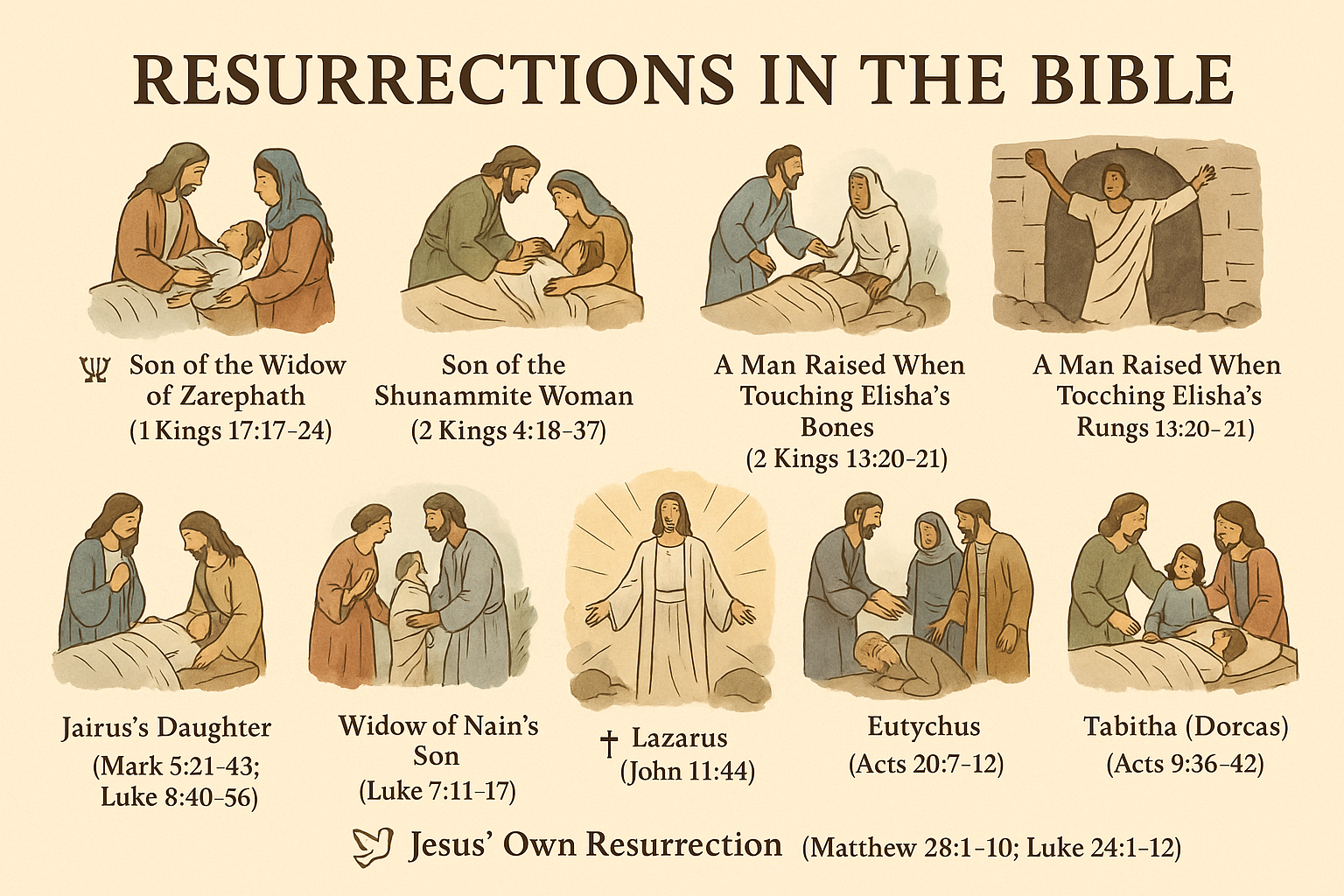
Here is a list of the resuscitations in the Bible, along with the context that might be seen as the “justifiable reason” you’re exploring.
Resuscitations in the Old Testament
These miracles established the authority of God’s prophets and showed His power over life and death, a power previously attributed only to God Himself.
- The Widow of Zarephath’s Son (1 Kings 17:17−24)
- Context: Raised by the prophet Elijah. The widow had previously shown incredible faith by providing for Elijah from her last bit of flour and oil during a severe famine. When her son died, she questioned Elijah, and in her desperation, he cried out to the Lord. The miracle served as a confirmation of both God’s power and Elijah’s authenticity as God’s prophet. The “justification” here is rooted in the mother’s prior faith and God’s desire to vindicate His prophet.
- The Shunammite Woman’s Son (2 Kings 4:18−37)
- Context: Raised by the prophet Elisha. This wealthy woman had shown great hospitality to Elisha, even building a room for him in her home without asking for anything in return. Elisha prophesied she would have a son, who later dies. Her determined faith is remarkable; she travels directly to Elisha, holding him accountable to the gift God gave through him. The miracle is a response to the mother’s persistent faith and a reward for her selfless hospitality.
- An Unnamed Man (2 Kings 13:20−21)
- Context: This is a unique case. During a burial, a dead man’s body was hastily thrown into the tomb of Elisha. Upon touching the prophet’s bones, the man came back to life. There is no information about the man himself. The purpose here seems entirely focused on God, demonstrating that His power, invested in His prophet, was so potent it lingered even after Elisha’s death. It’s a testament to the prophet, not the recipient.
Resuscitations by Jesus
Jesus’s miracles were different in that they pointed directly to His own divine identity as “the resurrection and the life” (John 11:25).
- Jairus’s Daughter (Matthew 9:18−26; Mark 5:21−43; Luke 8:40−56)
- Context: Jairus, a leader of the synagogue, humbled himself and showed profound faith by coming to Jesus and begging Him to heal his daughter. The miracle was a direct response to a father’s desperate and believing plea. It demonstrated Jesus’s authority not just over sickness, but over death itself, in a context of parental faith.
- The Widow of Nain’s Son (Luke 7:11−17)
- Context: Jesus and his disciples encountered a funeral procession. The deceased was the only son of a widow. The text explicitly states the motivation: “When the Lord saw her, his heart went out to her” (Luke 7:13). This miracle is a pure demonstration of divine compassion. The “justification” wasn’t the faith of the recipient or even a plea from the mother; it was Jesus’s unsolicited, heartfelt response to a woman’s devastating loss.
- Lazarus of Bethany (John 11:1−44)
- Context: Lazarus was a close friend of Jesus, and his sisters were Mary and Martha. The Bible notes, “Jesus loved Martha and her sister and Lazarus” (John 11:5). While the faith of the sisters is a key part of the story, Jesus explicitly states the primary purpose: “This sickness will not end in death. No, it is for God’s glory so that God’s Son may be glorified through it” (John 11:4). This was the most public and dramatic of Jesus’s resuscitations, done to build faith in His disciples and followers right before His own death and resurrection. The justification was both personal love and a strategic display of God’s glory.
Resuscitations by the Apostles
Performed after Jesus’s ascension, these miracles demonstrated that the power of Jesus now worked through His followers by the Holy Spirit.
- Tabitha (Dorcas) (Acts 9:36−42)
- Context: Raised by the apostle Peter. As you noted, Tabitha was “full of good works and acts of charity.” When she died, the believers (especially the widows she had helped) sent for Peter. They showed him the clothes she had made, weeping over their loss. The miracle was a response to the needs and the faith of the Christian community in Joppa, which deeply valued this woman. It affirmed Peter’s authority and caused many in the town to believe.
- Eutychus (Acts 20:7−12)
- Context: Raised by the apostle Paul. A young man named Eutychus fell asleep during Paul’s long sermon, fell from a third-story window, and died. Paul embraced him and declared he was alive. This miracle prevented a tragedy from overshadowing Paul’s farewell visit and served as a great comfort and encouragement to the believers. The context is less about the boy’s character and more about restoring a tragic situation and strengthening the church.
Common Theological Themes
You are right to look for a common thread. While the circumstances vary, the theme is not that good people are “more worthy” of being raised. Instead, these common elements emerge:
- A Response to Faith: Many of these miracles are directly linked to the faith of someone involved—Jairus’s plea, the Shunammite’s persistence, the Zarephath widow’s obedience, the Joppa community’s call for Peter.
- A Display of Compassion: The story of the widow of Nain is the clearest example, where the miracle is a spontaneous overflow of Christ’s compassion for human suffering. The raising of Tabitha also fits here, as it was a compassionate act for the grieving community.
- The Glory of God: This is the ultimate reason. In every case, the miracle points away from the person raised and toward the power of God, serving to authenticate His messengers (Elijah, Elisha, Jesus, Peter, Paul) and inspire belief in those who witnessed it.
- A Foretaste of What’s to Come: Theologically, these are all resuscitations (a return to mortal life), not resurrections to an eternal, glorified body like Christ’s. They act as powerful signs pointing to Jesus’s ultimate victory over death and the future resurrection promised to all believers.